
Infill lot financing supports the purchase or refinance of vacant or underutilized lots located within existing developed areas. Builders and investors often use infill lots for small development projects, replacement housing, or strategic land positions in established neighborhoods. Blue Dot Financial evaluates location, zoning, lot characteristics, borrower equity, market demand, and the planned exit. Investors can also review lot and land loans for real estate investors when evaluating broader land financing needs.
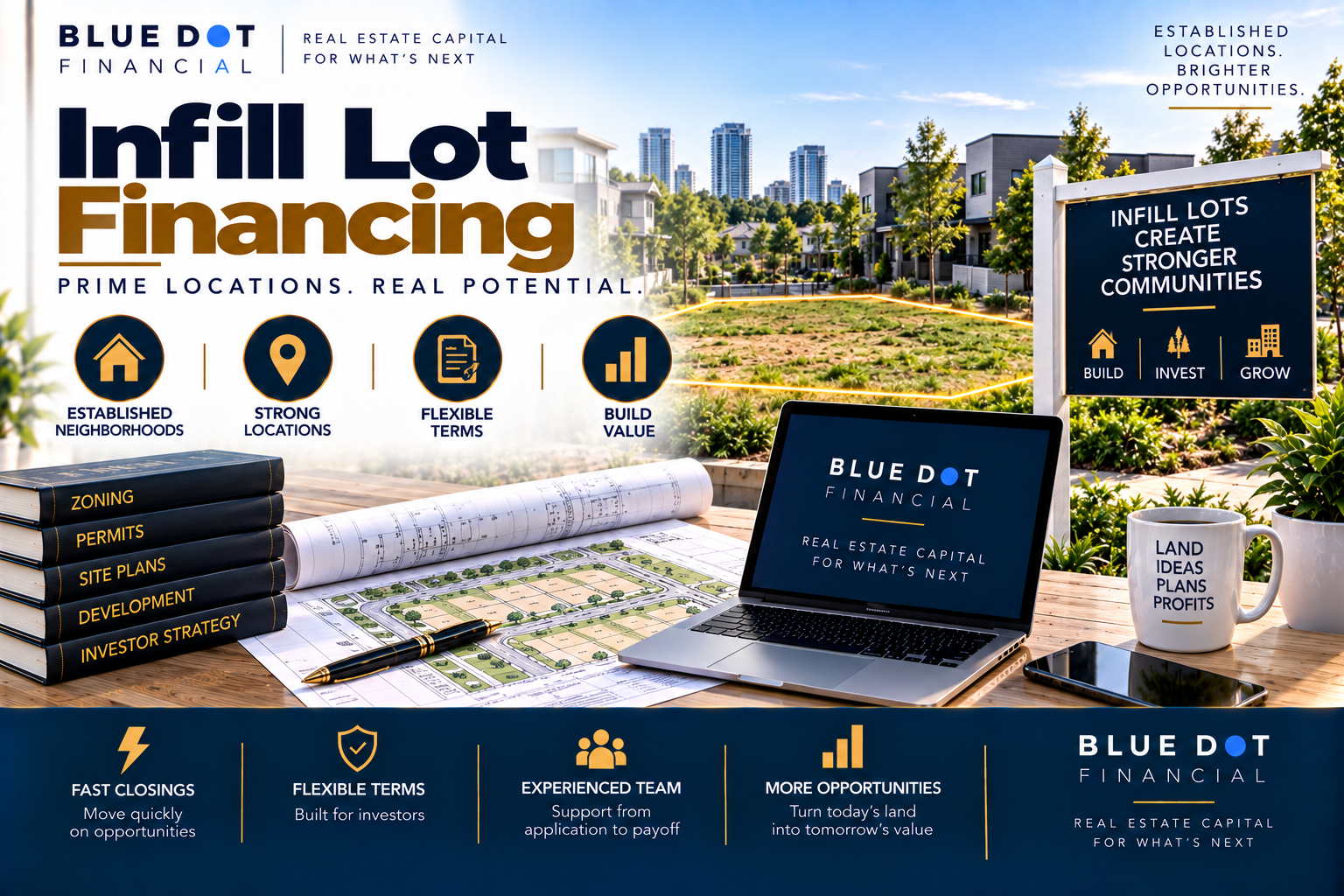
Infill Lot Financing matters because land, lots, and pre-development projects often do not fit standard residential or commercial loan boxes. The lender must understand the parcel, location, entitlement path, collateral value, and exit strategy. Borrowers can also explore asset-based real estate lending to understand how collateral and project economics may factor into a financing review.
This page is written for builders, developers, land investors, and operators acquiring or refinancing raw, entitled, infill, or pre-development land. It is especially useful for borrowers who want to understand whether infill lot financing can support a non-owner-occupied investment property strategy. Investors evaluating parcels with development approvals can also review entitled land financing.
Blue Dot Financial provides private real estate lending for investment projects where speed, collateral clarity, borrower readiness, and exit strategy matter. For infill lot financing, the review should focus on the asset, the borrower entity, the business-purpose use, the project economics, and the repayment plan. These considerations are also relevant to how private lenders underwrite real estate deals.
Land does not always produce income, and it may not have the same liquidity as improved property. That is why lenders look closely at location, zoning, utilities, access, entitlement status, borrower equity, and the exit plan. Borrowers evaluating less-developed parcels can also review raw land loans explained.
Blue Dot reviews the parcel, acquisition price, current use, zoning, entitlement status, comparable values, market demand, borrower plan, equity, and projected exit. For pre-development situations, the next financing or sale event must be clear. Borrowers preparing for an early-stage development project can also review pre-development bridge loans.
Land financing can fit raw land acquisition, infill lots, entitled parcels, improved lots, subdivided tracts, land banking, refinance, and pre-development bridge needs. Depending on the transaction and timing, investors may also consider bridge loans for real estate investors for short-term financing needs.
Borrowers should provide the purchase contract, parcel information, survey or plat if available, zoning details, entitlement documents if available, valuation support, entity documents, and exit strategy. Borrowers should also understand the structure of business-purpose real estate loans when financing investment and development properties.
| Consideration | Why It Matters |
|---|---|
| Collateral | The property or portfolio must support the requested loan amount and exit strategy. |
| Borrower entity | Blue Dot’s borrower-side loans are designed for business-purpose entities, not owner-occupied consumer mortgages. |
| Timeline | Fast closings require complete documentation, clean title coordination, and responsive borrower communication. |
| Exit strategy | Sale, refinance, payoff, or stabilization must be realistic and clearly documented. |
| Reserves | Liquidity helps protect the project from budget overruns, delays, and carrying-cost pressure. |